
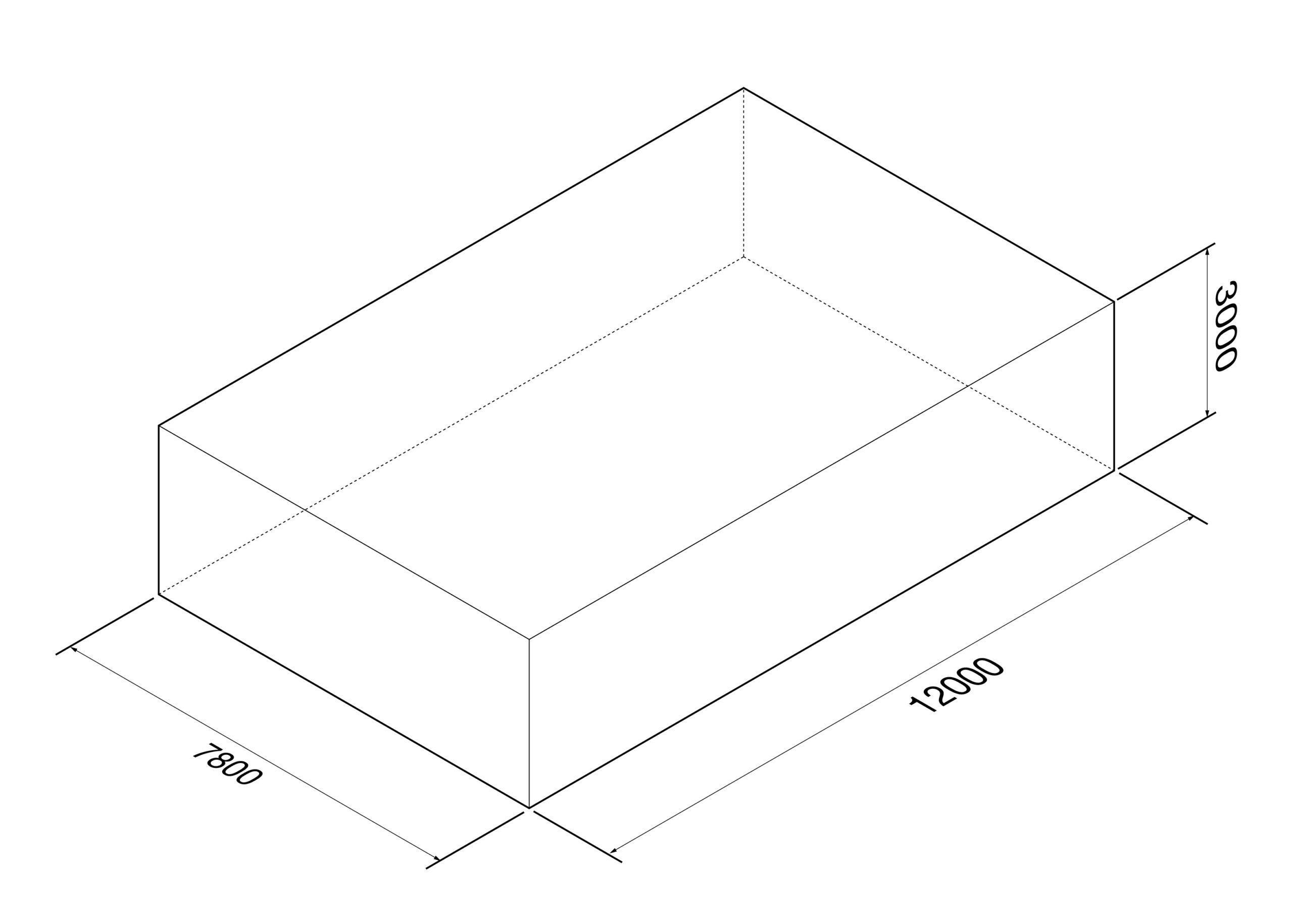
The above sketch shows the approximate size of LEEDS Studio in millimeters. Here is a base sketch with LEEDS studio in 3D and OSC Message integrated into the sketch: LEEDS_Base_Sketch
Below is a break down of the various elements of the sketch.
This is the main setup() and draw() functions of the sketch. The setup() functioncalls a function to create the CUI and starts the oscP5 listenign object. The draw() function draws a line through the stored positions of the marker being tracked and draws a point at its current postion.
import oscP5.*;
import netP5.*;
import controlP5.*;

//List to store positions of marker
ArrayList <PVector> trace = new ArrayList <PVector>();

//LEEDs dimensions in mm
float roomw = 12000;
float roomd = 7800;
float roomh = 3000;

/*port number to listen to. Make sure the port number in
Vicon Tracker is set to this*/
int Port_Number = 12000;

void setup() {
  //size(1200, 800, P3D);
  fullScreen(P3D);
  perspective(PI/3.0,(float)width/height,1,100000);

  /* start oscP5, listening for incoming messages at port number */
  oscP5 = new OscP5(this,Port_Number);

  //call function to create the GUI
  controls();
}

void draw(){
  background(0);

  PVector newpos1;
  PVector newpos2;

  if(trace.size() > 2){
    newpos1 = trace.get(trace.size()-1);
    newpos2 = trace.get(trace.size()-2);

    //distance between the last two points gives you the speed magnitude
    float dd = dist(newpos1.x,newpos1.y,newpos1.z,newpos2.x,newpos2.y,newpos2.z);

    //show the latest speed in the sketch
    textSize(15);
    fill(255);
    text("SPEED: "+ dd, 30, height-40);
  }

  pushMatrix();
  //call camera function
  cam();

  //room toggel is on then draw the room
  if(room_on){
    room(roomw,roomd,roomh);
  }

  stroke(0,255,255);
  strokeWeight(2);

  //draw lines between all of the stored postions of the tracked marker
  for(int i = 0; i < trace.size()-1; i++){
    newpos1 = trace.get(i);
    newpos2 = trace.get(i+1);
    stroke(255,0,0);
    line(newpos1.x,newpos1.y,newpos1.z,newpos2.x,newpos2.y,newpos2.z);
  }

  //draw a point at the latest position of the marker
  stroke(0,255,255);
  strokeWeight(10);
  point(Marker1_position.x,Marker1_position.y,Marker1_position.z);
  popMatrix();
}
This is the standard camera function we have been using.
///camera varibles
int oldx = mouseX;
int oldy = mouseY;
float rotx = 0;
float roty = PI/2.0;
float zcam = -7800;


float rotxdelta = 0;

void cam() {
  int newx = mouseX;
  int newy = mouseY;
  translate(width/2, height/2+roomh/2.0,zcam);
  rotateY(rotx);
  rotateX(roty);
  //rotateZ(PI);
  if ((mousePressed == true)) {
    rotx = rotx + (oldx-newx)/50.0;
    roty = roty + (oldy-newy)/50.0;
  }
  oldx = newx;
  oldy = newy;


  if(rotate_on == true){
    rotx = rotx+ 0.005;
  }
}

void mouseWheel(MouseEvent event) {
  float e = event.getCount();
  zcam = zcam - e*35;
}
This function sets up the contrils for the GUI.
ControlP5 cp5;

boolean room_on = true;
boolean rotate_on = true;

void controls(){
  cp5 = new ControlP5(this);

 cp5.addToggle("rotate_on")
     .setPosition(40,40)
     .setSize(20,20)
     .setValue(false)
     .setColorForeground(color(120,120,120))
     .setColorLabel(color(255))
     .setColorBackground(color(70,70,70))
     .setColorValue(color(0,0,0))
     .setColorActive(color(150,150,150))
     ;

   cp5.addToggle("room_on")
     .setPosition(40,80)
     .setSize(20,20)
     .setValue(true)
     .setColorForeground(color(120,120,120))
     .setColorLabel(color(255))
     .setColorBackground(color(70,70,70))
     .setColorValue(color(0,0,0))
     .setColorActive(color(150,150,150))
     ;
}
This is the fucntion that listens for incoming OSC data from Vicon Tracker.
//initialize OscP5 object for listening to the OSC stream
OscP5 oscP5;

/* Address pattern of a specific marker */
String Marker1_address = "/vicon/marker/Wood Block/Wood Block1";

/* Address pattern of a specific marker */
String Marker2_address = "/vicon/marker/Object/Object2";

PVector Marker1_position = new PVector(0,0,0);

/* incoming osc message are forwarded to the oscEvent method. */
void oscEvent(OscMessage theOscMessage) {
  /*find the message for a particular marker in the osc message*/
  if(theOscMessage.checkAddrPattern(Marker1_address)==true) {
      /* parse theOscMessage and extract the values from the osc message arguments. */
      float XPOS = theOscMessage.get(0).floatValue();
      float YPOS = theOscMessage.get(1).floatValue();
      float ZPOS = theOscMessage.get(2).floatValue();

      Marker1_position = new PVector(XPOS,YPOS,ZPOS);

      trace.add(Marker1_position);
  }

  if(theOscMessage.checkAddrPattern(Marker2_address)==true) {
      /* parse theOscMessage and extract the values from the osc message arguments. */
      float XPOS = theOscMessage.get(0).floatValue();
      float YPOS = theOscMessage.get(1).floatValue();
      float ZPOS = theOscMessage.get(2).floatValue();

      println(XPOS);

  }
}
This function draws the room as a wireframe.
//function to draw the room

void room(float w, float d, float h){

  stroke(255);
  strokeWeight(1);
  noFill();

  beginShape();


  vertex(-d/2, -w/2,0);
  vertex(d/2, -w/2,0);
  vertex(d/2, w/2,0);
  vertex(-d/2, w/2,0);
  vertex(-d/2, -w/2,0);
  endShape();

  beginShape();
  vertex(-d/2, -w/2,h);
  vertex(d/2, -w/2,h);
  vertex(d/2, w/2,h);
  vertex(-d/2, w/2,h);
  vertex(-d/2, -w/2,h);
  endShape();

  beginShape();
  vertex(d/2, -w/2,h);
  vertex(d/2, -w/2,0);
  vertex(d/2, w/2,0);
  vertex(d/2, w/2,h);
  vertex(d/2, -w/2,h);
  endShape();

   beginShape();
  vertex(-d/2, -w/2,h);
  vertex(-d/2, -w/2,0);
  vertex(-d/2, w/2,0);
  vertex(-d/2, w/2,h);
  vertex(-d/2, -w/2,h);
  endShape();
}